Marcoeconomics in the Age of AGI
Order Information
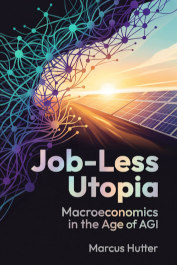
Title: Job-Less Utopia
Subtitle: Marcoeconomics in the Age of AGI
Publisher: AIXI Media,
ISBN: 978-1-0668284-1-8
Date: © 2026,
Pages: 260
Best price (UK&US only): IngramSpark (40% off)
The book is available for order in virtually any bookstore world-wide.
Please contact me for a free review copy.
Abstract
Job-Less Utopia explores macroeconomics in the age of AGI.
As artificial general intelligence (AGI) and advanced robotics decouple
economic productivity from human labor, mass un(der)employment is highly
probable. However, if the total volume of goods and services is maintained or
increased by automation, a post-labor economy is consistent with universal
material prosperity. This book explores the economics of an automated
society, demonstrating that maintaining full employment in such an economy
often leads to hyper-competition and socially wasteful (BS) jobs. The book
argues that a transition to Universal Basic Income (UBI) or structurally
adapted welfare is not only economically viable but highly desirable. It
addresses the practicalities of redistribution, economic objections, and the
societal shifts required to find human meaning and maintain democratic
stability in a world where human labor is no longer the engine of the economy.
Keywords:
Economics, Utopia, Jobs, Universal Basic Income, Citizens' Wealth Funds, Tax Categories, Artificial General Intelligence, Robotics, Automation, Technological Unemployment, Labor Displacement, Future of Work, Post-Labor Economy, Post-Scarcity, Wealth Redistribution, Zero Marginal Cost, Great Decoupling, Wage Erosion, BS-Jobs, BS-Tax, Hyper-Competition, Annoyance Economy, Land Value Taxation, Moravec Paradox, Democratic Stability, Meaning of Life, Meaning of Work, AI Colonialism, Premature Deindustrialization, Global Minimum Tax.
Short Table of Contents
- Introduction
- Foundations of a Post-Labor Economy
- The Economics of Automation
- The Illusion of Full Employment
- Redistribution Mechanisms
- Guaranteed Income
- Societal Transitions and The Future
- International Challenges
- Wider Considerations
- Discussion
- Full List of Arguments for UBI
- Full List of Arguments Why Jobs Will Disappear
Thirteen Theses
After 25+ years, I thought I try something new. I find the public and professional discussion about the future of Jobs in light of AGI jarring, with both sides largely missing the point (don't worry novel jobs will appear vs mass unemployed dystopia).
The book shows why a Job-Less future is desirable, affordable, and likely.
The book develops the case along thirteen theses:
- Total automation is inevitable: AGI and advanced robots will eventually perform virtually all cognitive and physical tasks better and cheaper than humans (Chapter 2).
- Material abundance is maintained: Replacing human workers with AI does not shrink the economy; the exact same (or a greater) volume of goods and services will still be produced (Chapter 3).
- Near-zero marginal costs: All supply chain costs ultimately trace back to human labor, raw materials, and energy. Automating labor and harnessing abundant energy will drive the production cost of most non-scarce goods and services remarkably close to zero (Chapter 3).
- The land bottleneck is solvable: Even at zero labor cost, land and scarce resources remain priced. Proven tools (land value taxation, sovereign resource funds, Harberger taxes) can capture these rents and channel them into GI (Chapter 3).
- The ‘New Jobs’ fallacy: The historical pattern of technology creating new human jobs will eventually end. The transition will be too fast for human retraining, and new roles will also be performed better by machines (Chapter 4).
- Meaning exists beyond employment: The psychological need for traditional employment is a product of modern cultural conditioning. Humans are naturally primed to find purpose in family, community, hobbies, learning, and structured competition (Chapter 7).
- Mass unemployment is a feature, not a bug: Un(der)employment is perfectly consistent with universal prosperity. The primary goal of an economy is to provide a decent standard of living, not to maximize human toil (Chapter 2).
- Forced employment is dystopian: Attempting to artificially maintain full employment in a highly automated society will trap humans in low-paying hyper-competition and socially wasteful (BS) jobs (marketing arms races, predatory finance, ...) (Chapter 4).
- UBI is economically affordable: Multiple complementary instruments can finance GI, either directly via automation, luxury, Pigouvian, land, inheritance, consumption, and service taxes, or indirectly via wealth funds, even cost-neutrally (Chapter 5).
- Alternative safety nets are inferior: Conditional welfare, job guarantees, and means-tested transfers re-introduce surveillance, conditionality, or BS-jobs that UBI avoids. Universal Basic Services can augment but not replace cash transfers. Blocking automation via regulation only halts progress (Chapter 6).
- Democracy is self-correcting: Failing to redistribute the wealth generated by AI risks severe inequality (Figures 5.3 and 7.5) and social unrest. In a functioning democracy, the displaced majority will vote for parties that enact redistribution; at the limit, the threat of civil unrest compels even reluctant capital owners to share the gains of automation (Chapter 7).
- International challenges are solvable: Global asymmetries and tax base erosion can be managed through tariffs, destination-based consumption taxes, digital services taxes, a global minimum tax, and international coordination (Chapter 8).
- Coordination failures become easier to address: By removing the desperation for employment, AGI paired with UBI deflates the pressure behind BS-jobs, marketing arms races, and exploitative gig work, creating political space for complementary institutional reforms (Chapter 10).
Reviews
Full reviews at GoodReads
and Amazon.
“It's good to see smart people like @mhutter42 thinking about the big
changes and the potential big problems (and big upshots!) they bring.
This is a worthy and much needed endeavour.”
– Prof. Csaba Szepesvari, Director at Google DeepMind
“This is a very topical book. As the world braces for AGI,
serious discussion of what kind of society we actually want to end with is badly needed.
What I like the most about the book is its directness
...
the book proceeds by making bold, clear claims ...
followed by supporting arguments and relevant discussion ...
More authors should write like this! ...
overall I found it inspiring, and an excellent addition
to an urgent topic for discussion.”
– Dr. Tom Everitt, AI Safety Researcher at Google DeepMind
“Wow @Marcus Hutter is there anything you can’t do??!”
– Dr. Elija Perrier, Fellow at the University of Technology, Sydney
“Its the best long form argument I've seen against the common
`lump of labor fallacy means humans always have jobs'
position many economists hold.”
– Autoencoded
Public Discussion
I still don't have my own blog and may never have,
but fortunately the book has and can be discussed at various other places:
For instance
Or start a new blog post at your favorite place.
Feedback
Please email me for any errors or inaccuracies or omissions you find or any other suggestion.
Your suggestions will be considered for the next print or online edition.
BibTeX Entry
@book{Hutter:26jobsubi,
  title     = {{Job-Less Utopia: Macroeconomics in the Age of AGI}},
  author    = {Marcus Hutter},
  year      = {2026},
  month     = jul,
  pages     = {260},
  publisher = {AIXI Media},
  isbn      = {978-1-0668284-1-8},
  hardcover = {http://www.justbooks.co.uk/?isbn=9781066828418},
  website   = {http://www.hutter1.net/ai/jobsubi.htm},
  discuss   = {http://www.lesswrong.com/posts/bPuMatTPjfJCfXiAB/job-less-utopia-macroeconomics-in-the-age-of-agi},
  pdf       = {http://www.hutter1.net/publ/jobsubi.pdf},
  slides    = {http://www.hutter1.net/publ/sjobsubi.pdf},
  video     = {http://youtu.be/4efgvM3APqI},
  synopsis  = {Argues that AGI-driven automation will make most human labor obsolete,
               and that UBI funded by AI-generated wealth can sustain
               universal prosperity without compulsory employment.}
}
| © 2000 by ... |
| ... Marcus Hutter |
 Order Information